
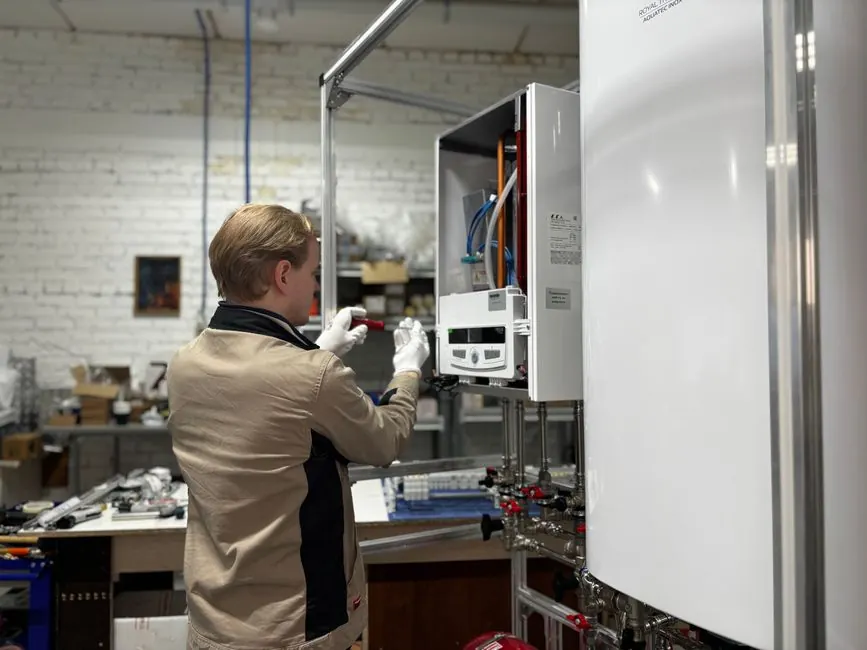
Regular boiler maintenance is mostly about observation, safe access, and qualified service rather than guesswork or DIY disassembly.
Short answer
Good boiler maintenance starts with simple observation and scheduled professional service. Homeowners can watch for leaks, unusual noises, pressure changes, slow heating, blocked vents, and thermostat problems. A qualified provider should handle combustion checks, burner work, control testing, flushing decisions, safety devices, and any repair that requires opening the boiler or altering piping.
Maintenance is not a guarantee that a boiler will never fail, but it helps catch small issues before they become harder to diagnose. In Medford, where heating systems may include hot-water baseboard, radiators, steam components, or older piping, the useful goal is not just a clean appliance. The useful goal is a system that heats evenly, circulates properly, vents safely, and can be serviced without confusion.
What homeowners can safely monitor
Walk around the boiler area periodically during the heating season. Look for water on the floor, rust trails, staining near relief piping, loose insulation, or new smells. Listen for banging, grinding, whistling, repeated clicking, or short cycling. Note whether the system takes longer than usual to recover after a thermostat setback.
Check the thermostat settings and make sure furniture or stored items are not blocking radiators or baseboard covers. If your system has a visible pressure gauge, record what it reads when the system is cool and when it is hot. Do not add water repeatedly or reset controls again and again without asking why the system needs it.
What a professional maintenance visit may include
A provider may inspect visible piping, valves, circulators, wiring, venting, controls, and safety devices. Depending on the boiler type, service may include burner inspection, cleaning, combustion-related checks, condensate review, pressure verification, expansion tank evaluation, and confirmation that pumps or zone valves respond correctly.
The scope should match the system. A steam boiler, cast-iron hot-water boiler, modern gas boiler, oil-fired boiler, and combi boiler do not all need the same checklist. Ask what is included before booking, and ask the provider to explain any recommended repair separately from routine maintenance.
When flushing or cleaning may be discussed
Power flushing or hydronic cleaning may be useful when there is evidence of circulation restriction, sludge, cold sections, repeated dirty water, or component issues related to debris. It is not automatically the answer to every cold room. A provider should first rule out thermostat, zone valve, pump, pressure, balancing, and air problems.
If cleaning is recommended, ask what signs support it, what parts of the system will be included, how vulnerable components will be protected, and whether any valves or weak fittings could leak once disturbed. For more detail, see boiler maintenance and power flushing.
Winter preparation
Before cold weather, test the system early enough to schedule help if something does not work. Turn heat on before the first hard cold spell and confirm that each zone responds. Check that vents and exterior terminations are clear where visible and safe to inspect. Clear stored items away from the boiler so a provider can access it.
If the home has vacant areas, finished basements, or multi-zone heat, note which rooms lag behind. Slow response can point to circulation, insulation, radiator, or control issues. Early notes make a repair visit more productive.
When to request repair instead of maintenance
Maintenance is not the right appointment for active leaks, carbon monoxide alarms, burning smells, severe pressure problems, repeated lockouts, or a boiler that will not heat the property. Those issues require repair evaluation and safety judgment. If you see water, review leak and pressure repair. If heat does not move through the system, review circulator pump repair and zone valve repair.
Maintenance notes worth keeping
A simple maintenance log can make future service visits more useful. Record the date of each professional visit, what was inspected, what parts were replaced, pressure readings if provided, and any recommendations that were deferred. Keep photos of model plates, visible piping labels, and control panels. These notes help a provider understand the system history without relying on memory during a no-heat call.
Also record recurring symptoms even when they seem minor. Examples include one room lagging behind, a pressure gauge that changes more than it used to, a relief pipe that shows staining, a pump that has become louder, or radiators that repeatedly need attention. Small patterns can point to air entry, pressure control problems, circulation restriction, or a control issue that routine maintenance should investigate.
Maintenance should not be treated as a one-size package. Ask what the provider recommends for your exact equipment and distribution system. A steam system, oil-fired boiler, gas boiler, combi boiler, and hydronic baseboard system each has different service priorities. The best maintenance conversation connects the appliance, the controls, and the rooms being heated.
What to ask after the visit
Before the provider leaves, ask what was checked, what readings or observations mattered, and whether any item should be monitored. If a part is aging but not failed, ask what symptom would indicate it is getting worse. If the system was adjusted, ask what changed and whether you should expect different sounds, pressure behavior, or warmup timing.
Keep the invoice and notes with your boiler information. If another provider visits later, those details can prevent repeat diagnosis and help separate a new fault from a known condition. Good maintenance records are especially useful when a home has multiple zones, older radiators, or a mix of finished and unfinished spaces.